
Second chances on two wheels: Repaired Bikes, Less Waste and World Bicycle Day
World Bicycle Day is on 3 June, and it’s a great reminder that bikes are more than just a way to get from A to B.
They’re affordable transport. They’re exercise. They’re freedom for kids. They’re a low-emission way to get around. And, when repaired and reused, they’re a great example of the circular economy in action.
At Wāhi Tukurua, bikes don’t usually arrive shiny and new.
They roll in, wobble in, or get carried through the door. Some are rusty, dusty, flat-tyred and full of potential. Others arrive in surprisingly good condition, needing little more than a clean, a check-over and a bit of care.
Over a recent four-month period, 20 bikes came through our workshop.
Of those, three were in great condition and quickly found new homes. Seven were too far gone to safely repair, so they were carefully stripped for parts and recycling. The remaining ten were repaired, checked and brought back to life.
That’s ten bikes given a second chance.
Why repairing bikes matters
Repairing bikes keeps useful materials out of landfill and reduces the need to buy new.
A bike that might have been seen as “rubbish” can often become roadworthy again with the right skills, tools and time. Sometimes it’s as simple as pumping tyres, oiling a chain and adjusting brakes. Other times it takes a bit more work, like replacing cables, tuning gears or sourcing parts.
Either way, repair is practical waste minimisation.
It saves resources, extends the life of the item and gives someone in the community access to a bike at a fraction of the cost of buying new.
Safety comes first
Every bike that comes through the Wāhi Tukurua workshop is assessed carefully.
Before a repaired bike is sold, our team checks the important things: brakes, gears, tyres, chains, cables and overall condition. A bike leaving the workshop needs to be more than just rideable. It needs to be reliable.
Some bikes simply can’t be safely repaired. When that happens, we strip what we can and recycle what is left.
Even then, the bike still has value. Parts can be reused. Materials can be recovered. Less goes to landfill.
Affordable bikes for the community
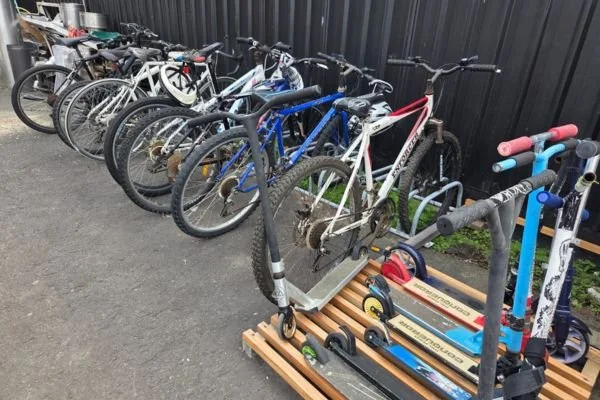
The repaired bikes at Wāhi Tukurua are available for sale.
That means locals can pick up a checked, ready-to-ride bike without the cost of buying brand new. Whether it’s for riding to school, getting to work, heading to the shops or just enjoying some fresh air, a second-hand bike can be a great option.
It also helps keep this work going.
Every bike sold supports local reuse, local jobs and future repairs. It helps us keep the workshop running, keep items moving, and continue finding practical ways to divert useful things from landfill.
Bike repairs by arrangement
We also offer bike repairs by arrangement.
If you have a bike sitting in the shed, garage or under the house that needs some attention, it may not be the end of the road. A repair might be all it needs to get rolling again.
Before replacing it, consider whether it can be fixed.
A circular economy on wheels
There’s something special about watching a child wobble off on a “new” old bike, or seeing an adult rediscover the simple joy of riding.
These bikes don’t just move people from place to place. They carry stories forward.
They remind us that reuse doesn’t have to be complicated. Sometimes it looks like a repaired brake cable, a pumped-up tyre, an oiled chain and a second chance.
This World Bicycle Day, we’re celebrating the bikes, the repairers, the riders and the simple idea that useful things deserve another life.
Twenty bikes. Ten second chances. A workshop full of tools and know-how.
The circular economy, rolling along — one set of wheels at a time.
